Datasphere Blog-Digest

Dauerhaftes Archiv · Quelle: SAP Community via sap-docs · SAP Datasphere, SAP Business Data Cloud und SAP Databricks

Archivkopie: 69 Beiträge · Stand: 15.10.2026 06:58 UTC

Zeitraum:

Prüfe Server …

Recherche: noch kein protokollierter Importlauf.

Volltextsuche (alle gespeicherten Blogs)

Min. 2 Zeichen eingeben.

Blog-Screenshot groß

User Insights: SAP Business Data Cloud practitioners’ recommendations for a Business AI foundation

Relevanz: mittelSAP Business Data CloudSAP Datasphere14.10.2026 · · 1 Likes

  • Der Business AI Builder-Praktiker-Profil definiert die Kernfragen für eine Business-AI-Grundlage: Können SAP-Transaktionen mit externen Signalen kombiniert werden? Sind die Definitionen konsistent? Können Data Scientists ohne Neuaufbau der Unternehmenssemantik trainieren?
  • Semantik, Maschinelles Lernen und Konsum sollten getrennt architekturiert werden – wiederverwendbare Business-Logik und Hierarchien in Datasphere modellieren, um Konsistenz über Reports, Dashboards und Planungs-Geschichten zu sichern.
  • Data Products sind die wiederverwendbare Liefer-Einheit: verpacken Sie Daten, Business-Definitionen, Besitzrecht und Governance in Assets, die über Analytics und AI-Initiativen wiederverwendbar sind – kontinuierliche Lieferung statt Einzel-Extracts.
  • Praktischer Checklisten-Ansatz: vor der Produktion mit einem fokussierten Use Case beginnen, externe Daten (Inflation, Währung, geopolitische Störungen) von Anfang an einplanen, Governance und Zugriffsentscheidungen in die Architektur aufnehmen.
SAP Datasphere Replication Flow Fails with CDS Views Having No Key Fields — What Actually Happens?

Relevanz: hochSAP Datasphere14.10.2026 · · 0 Likes

  • Ein Replication Flow in SAP Datasphere erfordert Schlüsselfelder in der CDS-View, da diese die Eindeutigkeit von Datensätzen für Insert/Update/Delete-Operationen sichern; ohne definierte Schlüssel bricht der Flow fehl.
  • Diagnose beginnt mit der Prüfung der CDS-View in SAP S/4HANA auf definierte Primärschlüssel, gefolgt von der Validierung der Replication-Flow-Konfiguration in SAP Datasphere.
  • Eine CDS-View kann in S/4HANA gültige Daten liefern und dennoch für den Datasphere-Replication-Flow ungeeignet sein – allein die Schlüsselstruktur entscheidet über die Eignung.
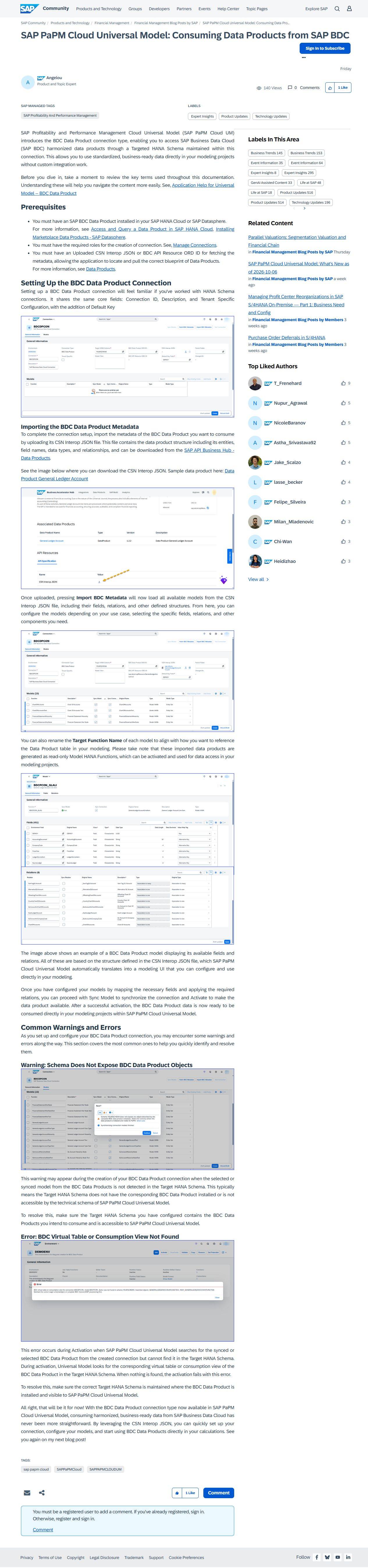
Screenshot: SAP PaPM Cloud Universal Model: Consuming Data Products from SAP BDC

SAP PaPM Cloud Universal Model: Consuming Data Products from SAP BDC

Relevanz: hochSAP Business Data CloudSAP Datasphere9.10.2026 · SAP · 1 Likes

  • SAP PaPM Cloud Universal Model führt einen neuen BDC Data Product-Connection-Typ ein, der harmonisierte Data Products aus SAP BDC über ein Targeted HANA Schema anspricht – ohne Custom-Integration in Modellierungsprojekte.
  • Einrichtung: CSN Interop JSON oder BDC API Resource ORD ID aus dem SAP API Business Hub hochladen, Import BDC Metadata ausführen, Modelle konfigurieren, Sync Model und Activate – importierte Data Products sind read-only Model HANA Functions.
  • Häufige Fehler: Warnung Schema Does Not Expose BDC Data Product Objects und Error BDC Virtual Table or Consumption Not Found während Activation – beide bedeuten, dass das Target HANA Schema das Data Product nicht enthält oder für PaPM Cloud nicht sichtbar ist.
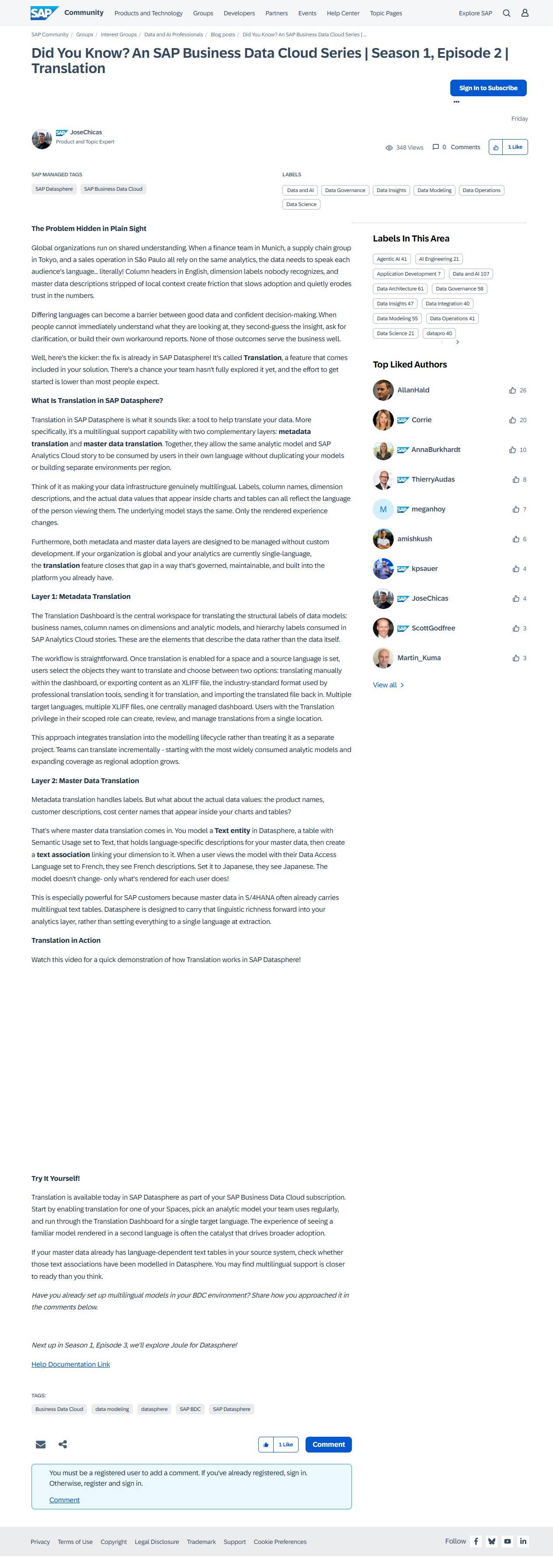
Screenshot: Did You Know? An SAP Business Data Cloud Series | Season 1, Episode 2 | Translation

Did You Know? An SAP Business Data Cloud Series | Season 1, Episode 2 | Translation

Relevanz: hochSAP DatasphereSAP Business Data Cloud9.10.2026 · Community · 1 Likes

  • SAP Datasphere bietet die integrierte Translation-Funktion zur Mehrsprachigkeit von Metadaten und Masterdaten – ohne eigene Entwicklung; Metadata-Translation über die Translation-Dashboard per manueller Eingabe oder XLIFF-Export/Import, Masterdaten-Translation über eine Text Entity-Tabelle mit Semantic Usage: Text und Text Association zur Dimension.
  • Die Translation-Funktion ist in SAP Datasphere als Teil des SAP Business Data Cloud-Abonnements enthalten; Aktivierung pro Space mit Quellsprache, danach inkrementelle Übersetzung der genutzten analytischen Modelle und SAC-Storys.
  • S/4HANA-Masterdaten mit mehrsprachigen Text-Tabellen können direkt in die Datasphere-Analyse-Schicht übernommen werden, anstatt alles auf eine Sprache festzulegen – die Sprachauswahl erfolgt pro Nutzer über Data Access Language.
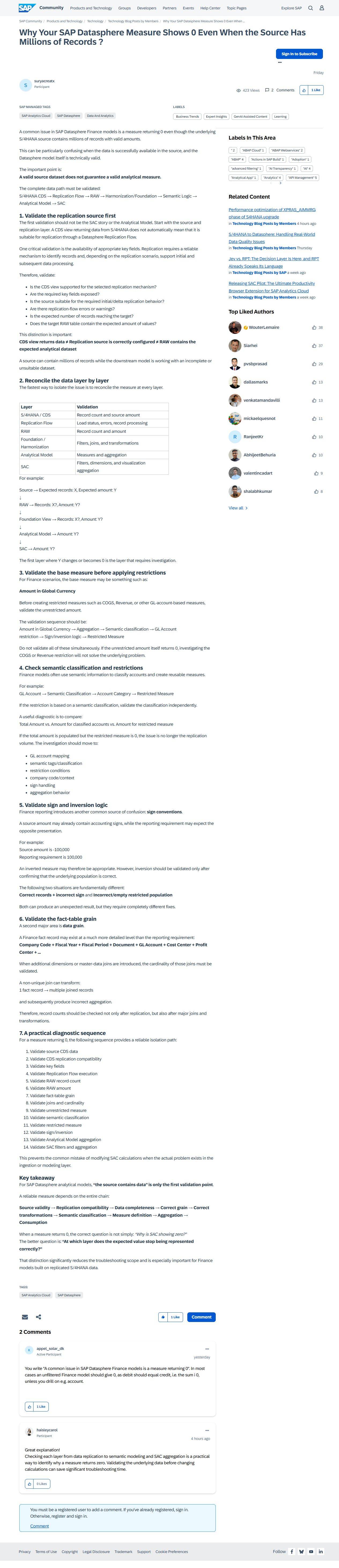
Screenshot: Why Your SAP Datasphere Measure Shows 0 Even When the Source Has Millions of Records ?

Why Your SAP Datasphere Measure Shows 0 Even When the Source Has Millions of Records ?

Relevanz: hochSAP Datasphere9.10.2026 · Community · 1 Likes

  • Die vollständige Datenpfad-Validierung von S/4HANA CDS über Replication Flow, RAW, Harmonization/Foundation, Semantic Logic, Analytical Model bis SAC muss durchlaufen werden, wenn ein Measure fälschlicherweise 0 anzeigt; ein gültiger Source-Datensatz garantiert kein gültiges analytisches Measure.
  • Der erste Validierungsschritt ist die Replication-Source und nicht der SAC-Story oder das Analytical Model; eine CDS-View mit Daten bedeutet nicht automatisch Eignung für den Replication Flow.
  • Schlüsselverfügbarkeit ist eine kritische Validierung – Replication erfordert ein zuverlässiges Mechanismus zur Datensatzidentifikation und -verarbeitung; ohne diesen bricht die Datenlieferung ab.
Screenshot: Managing the Custom Data Product Lifecycle in SAP Datasphere / SAP BDC

Managing the Custom Data Product Lifecycle in SAP Datasphere / SAP BDC

Relevanz: hochSAP DatasphereSAP Business Data Cloud9.10.2026 · SAP · 3 Likes

  • Der Data-Product-Lebenszyklus im Data Sharing Cockpit von SAP Datasphere / SAP BDC umfasst Listing, Versionierung, Artifact-Aktualisierung und Retirement; Verwaltung erfolgt über My Data Products unter Utilities → Data Sharing Cockpit, nicht als eigenständige App.
  • Delta-Share-Produkte (Formation BDC) unterscheiden sich von Public Data Marketplace-Produkten grundlegend im Liefermodus (Delta Share vs. Full/Live Access) und im Verwaltungskontext (Formations vs. Public Marketplace).
  • Jeder Statuswechsel eines Data Products unterliegt spezifischen Regeln für die möglichen nächsten Schritte; die Dokumentation listet die zulässigen Übergänge zwischen den Lifecycle-Status auf.
Screenshot: SAP Business Data Cloud and Datasphere News in September

SAP Business Data Cloud and Datasphere News in September

Relevanz: mittelSAP Business Data CloudSAP Datasphere6.10.2026 · Community · 2 Likes

  • Replication Flows: Delta Load für Local Tables (File/Object Store) als Source sowie Transport von Runtime-Settings.
  • Translation-Robustheit: Validierung von Text-Entities + Fallback-Text bei fehlender Übersetzung.
  • Data-Product-Governance live: Contracts/Agreements mit Terms-Akzeptanz, Steward-Approval, Auto-Approval für Low-Risk.
  • Object-Store-Metering in 3 Kategorien (Control Plane / Read / Write) im Capacity Monitor.
Screenshot: Data Access Control (DAC) Scenarios in SAP Datasphere

Data Access Control (DAC) Scenarios in SAP Datasphere

Relevanz: hochSAP Datasphere2.10.2026 · Community · 1 Likes

  • Regelsammlung an State/Category-Beispielen (Kaggle Sales Data): Einzel- und Mehrfach-DACs mit OR-/AND-Logik, Unrestricted-Werten (*), Exclusions, überlappenden Gruppen und konfligierenden Regeln ohne Treffer.
  • Vorgehen: Permission-Tabelle → DAC → Zuweisung an Views/Analytic Models; Best Practice ist ein eigener Permission-Space nur für Security-Verantwortliche.
  • Jeder Fall mit Screenshots und SAC-Ergebnis validiert.
★
Screenshot: Understanding Capacity Unit Consumption in SAP BDC and SAP Datasphere from Technical Perspective

Understanding Capacity Unit Consumption in SAP BDC and SAP Datasphere from Technical Perspective

Relevanz: hochSAP DatasphereSAP Business Data Cloud2.10.2026 · SAP · 8 Likes

  • Kernunterscheidung Always-On (HANA Compute Memory, Disk, Data Lake, Object Store, BW Bridge: Zähler läuft ab Provisionierung, kein kostenloser Leerlauf) vs. Activity-Triggered (DI Hours, ECN-Burst: nur bei Ausführung).
  • CU Estimator als maßgebliche Quelle für Sizing und Preise; der Blog erklärt jede Kachel aus technischer Sicht, nennt aber bewusst keine Preisbeträge.
  • Scope: Datasphere plus BDC-Dienste Data Lake, BW Bridge, Object Store, ECN, POI und BDC Connect; AI Units werden separat, Databricks/SAC/HANA gesondert abgerechnet.
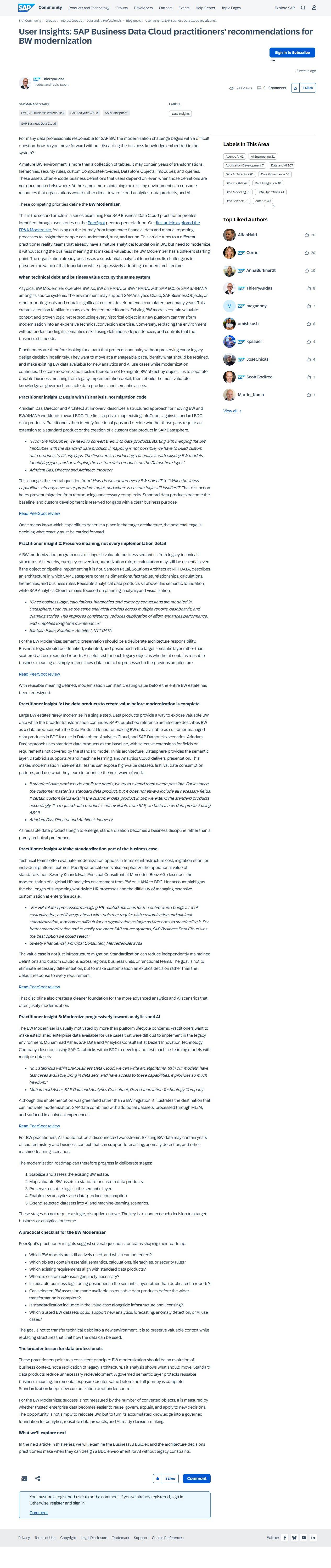
Screenshot: User Insights: SAP Business Data Cloud practitioners' recommendations for BW modernization

User Insights: SAP Business Data Cloud practitioners' recommendations for BW modernization

Relevanz: mittelSAP Business Data CloudSAP Datasphere30.9.2026 · Community · 3 Likes

  • Leitprinzip (PeerSpot-Praktiker): Business Meaning von Implementierungsdetail trennen — wertvolle Semantik (Hierarchien, Berechtigungen, Regeln) als governed Data Products/semantische Assets neu aufbauen statt Objekt-für-Objekt zu migrieren.
  • Insight 1: Fit-Analyse zuerst (InfoCubes gegen Standard-Data-Products mappen, Gaps per Custom Products in Datasphere schließen) statt Migrationscode.
  • Insight 2: nur Bedeutungsvolles mitnehmen; Standardprodukte als Baseline, Custom nur mit Business-Zweck.
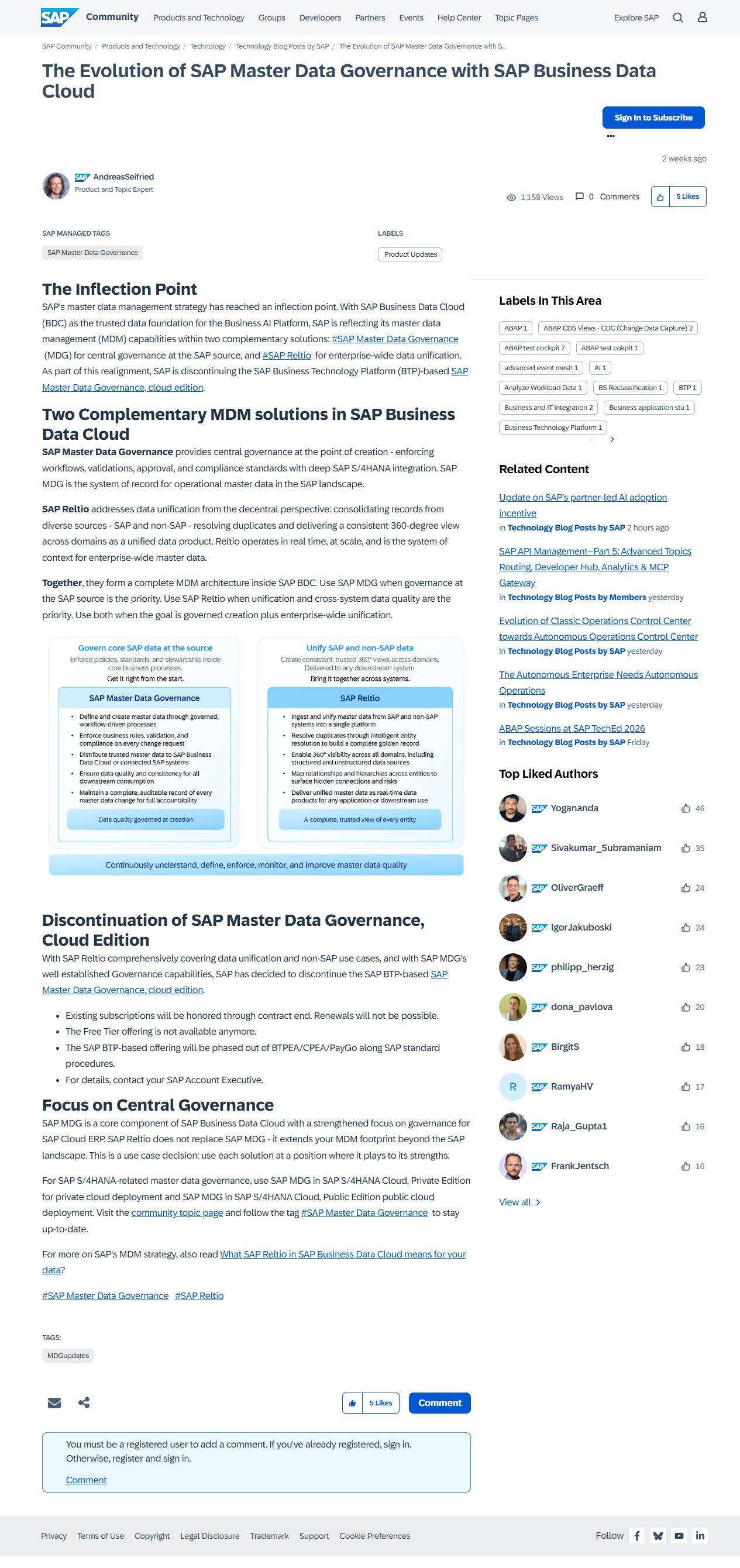
Screenshot: The Evolution of SAP Master Data Governance with SAP Business Data Cloud

The Evolution of SAP Master Data Governance with SAP Business Data Cloud

Relevanz: mittelSAP Business Data Cloud30.9.2026 · SAP · 5 Likes

  • Strategie-Weiche: MDG (Governance an der Quelle, S/4-nah) plus Reltio (Vereinheitlichung, 360°) als BDC-Duo; BTP-basiertes MDG Cloud Edition wird abgekündigt (Verträge laufen aus, keine Renewals/Free Tier).
  • Entscheidungsregel: SAP-Quell-Governance → MDG (Public/Private je Deployment), quellenübergreifende Qualität → Reltio; beides bei governed creation + unification.
  • Community-Tags (MDG-Topic-Page) zum Dranbleiben empfohlen.
Screenshot: Publish SAP Databricks Views as Custom Data Products in SAP Business Data Cloud

Publish SAP Databricks Views as Custom Data Products in SAP Business Data Cloud

Relevanz: hochSAP DatabricksSAP Business Data Cloud29.9.2026 · SAP · 6 Likes

  • Neu: BDC Connect SDK publiziert SAP-Databricks-Views (nicht nur physische Tabellen) als Custom Data Products — Typkonflikte löst ein View per CAST/HEX/TO_JSON auf SQL-Ebene.
  • Ablauf: View anlegen → pip install sap-bdc-connect-sdk → Share mit ORD-Metadaten registrieren → CSN generieren/registrieren → publish_data_product; kein Primary Key nötig.
  • View als Data Contract: sauberes typisiertes Schema für Konsumenten, Rohtabelle bleibt unberührt.
★
Screenshot: Connect to AWS S3 using SAP Cloud Connector for SAP Datasphere Replication flows

Connect to AWS S3 using SAP Cloud Connector for SAP Datasphere Replication flows

Relevanz: mittelSAP Datasphere29.9.2026 · SAP · 1 Likes

  • Architektur: S3 → VPC Interface Endpoint (PrivateLink) → EC2 mit SAP Cloud Connector → TLS-Tunnel nach Datasphere; kein Traffic über öffentliches Internet.
  • Schritte: EC2 (RHEL/AL2023, mind. 2 vCPU/4 GB), S3-Zugriff per AWS-CLI über Endpoint-DNS verifizieren, Cloud Connector (Linux Portable plus Machine JRE) installieren und als Replication-Flow-Quelle anbinden.
  • Ausdrücklich Lab-/POC-Charakter, kein Production-Setup.
Screenshot: Dynamic Top-N Waterfall Analysis in SAP Analytics Cloud: Why I Moved Ranking to SAP Datasphere

Dynamic Top-N Waterfall Analysis in SAP Analytics Cloud: Why I Moved Ranking to SAP Datasphere

Relevanz: mittelSAP Datasphere29.9.2026 · Community · 1 Likes

  • Pattern: Top-6-Treiber plus „All Others“ nicht in SAC per Scripting, sondern in Datasphere berechnen; SAC übergibt den analytischen Kontext (Region, BU, Periode, Version) als Input-Parameter.
  • Datasphere aggregiert Version A/B, berechnet Varianzen, rankt und liefert genau 7 Zeilen zurück — SAC bleibt reine Visualisierung.
  • Faustregel: große Treffermengen nie in die Visualisierungsschicht holen, wenn die Datenschicht die finalen Zeilen bestimmen kann.
Screenshot: Building Your First Data Product in SAP Datasphere: Step-by-Step Practical Guide

Building Your First Data Product in SAP Datasphere: Step-by-Step Practical Guide

Relevanz: hochSAP Datasphere29.9.2026 · Community · 6 Likes

  • End-to-End-Kette: Space → Tabelle plus Daten → Graphical View → Expose/Deploy → Context Management → Data Provider Profile → Data Product → Publish → Consumption.
  • Klare Abgrenzung: Tabelle (physischer Speicher), View (modellierte Sicht), Analytical Model (semantisch), Data Product (governed, mit Metadaten, Ownership und Doku).
  • Typische Anfängerfehler: falscher Space, fehlende User/Rollen, falsche Storage-Konfiguration, Space nach Anlage nicht aktiviert.
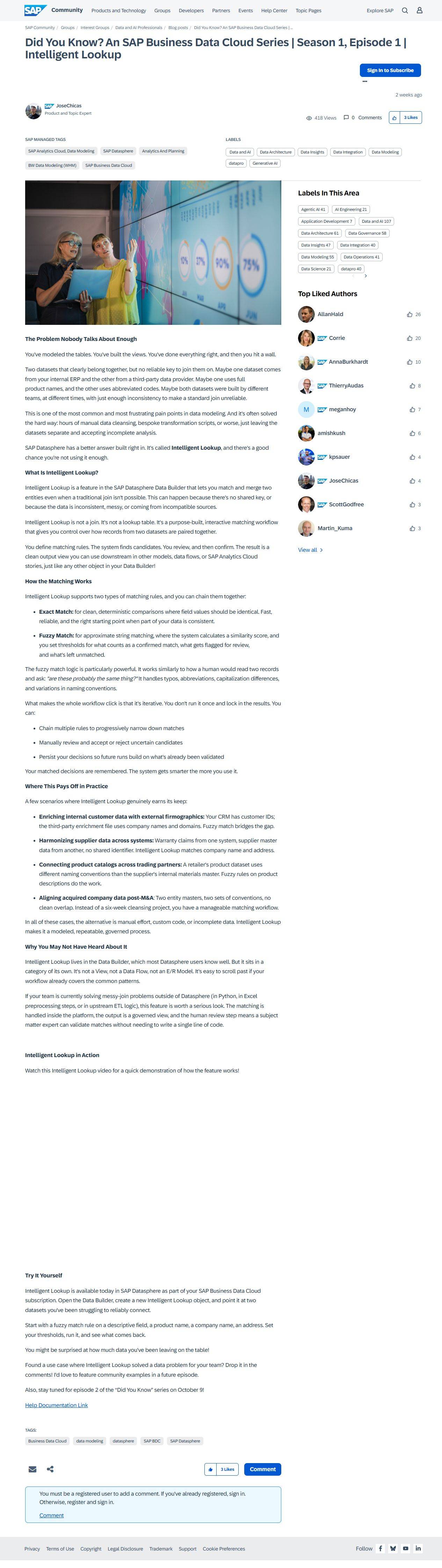
Screenshot: Did You Know? An SAP Business Data Cloud Series | Season 1, Episode 1 | Intelligent Lookup

Did You Know? An SAP Business Data Cloud Series | Season 1, Episode 1 | Intelligent Lookup

Relevanz: mittelSAP Business Data CloudSAP Datasphere28.9.2026 · Community · 3 Likes

  • Intelligent Lookup (Data Builder) matcht Entities ohne verlässlichen Join-Key: Exact Match (deterministisch) plus Fuzzy Match (Score + Thresholds für Confirm/Review/Unmatched), verkettbar, Entscheidungen persistent.
  • Use Cases: CRM + Firmographics, Lieferanten-Harmonisierung, Produktkataloge über Partner, M&A-Master-Abgleich (Typos, Abkürzungen, Cases).
  • Ergebnis ist ein Output-View für Modelle/Flows/SAC — Serie mit S1E2 Translation (bereits im Index).
Screenshot: What AI-Native, Autonomous Master Data Looks Like in SAP Business Data Cloud

What AI-Native, Autonomous Master Data Looks Like in SAP Business Data Cloud

Relevanz: hochSAP Business Data Cloud28.9.2026 · Community · 8 Likes

  • Arbeitsteilung: MDG = Governance an der SAP-Quelle (Workflows, Validierung, S/4-Integration), Reltio = Vereinheitlichung über SAP/non-SAP (Dedup, 360°-Sicht, Echtzeit) — Ergebnis als Unified Data Products für SAC, BDC Connect, Joule/Agents.
  • AI-native als Designphilosophie: Matching beim Laden, Agenten-Enrichment mit Drittdaten, weniger manuelle Reviews.
  • Kontext: MDM-Renaissance durch AI-Druck; Vorgängerblog zur Architektur verlinkt.
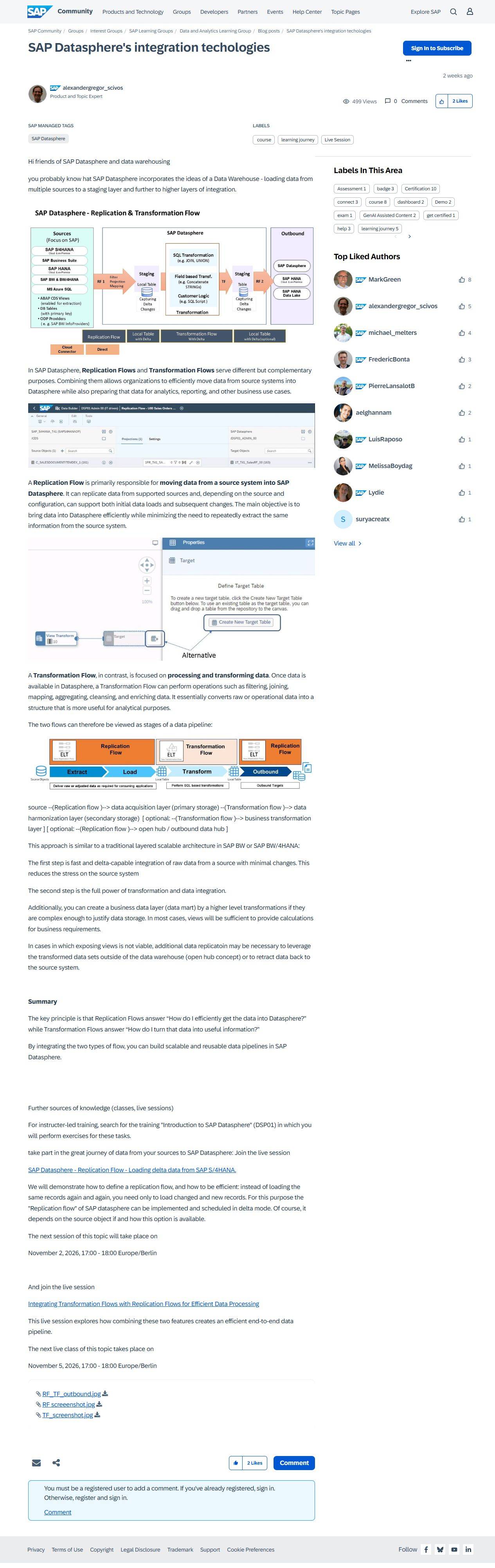
Screenshot: SAP Datasphere's integration techologies

SAP Datasphere's integration techologies

Relevanz: mittelSAP Datasphere28.9.2026 · Community · 2 Likes

  • Merksatz: Replication Flows bringen Daten effizient nach Datasphere (Initial plus Delta, quellschonend); Transformation Flows bereiten sie auf (Filtern, Joinen, Aggregieren, Cleansen).
  • Pipeline-Stufen: Acquisition → Harmonization → optional Business-/Mart-Layer; Views reichen meist, Persistierung nur bei Bedarf (Open Hub, Retraktion).
  • Analogie zur BW-Schichtenarchitektur; Verweis auf Training DSP01 und Live-Session zu Delta-Loads aus S/4HANA.
Screenshot: Unlocking Currency Conversion in SQLScript with CONVERT_CURRENCY() in SAP HANA XSA and Datasphere

Unlocking Currency Conversion in SQLScript with CONVERT_CURRENCY() in SAP HANA XSA and Datasphere

Relevanz: mittelSAP Datasphere28.9.2026 · Community · 1 Likes

  • CONVERT_CURRENCY() nutzt das SAP-Standard-Framework (Betrag, Quell-/Zielwährung, Stichtag, Kurstyp, Fehlerbehandlung) statt eigener Kurslogik — gleiche Konzepte wie die Calculation-View-Semantik.

  • HDI-Pattern: TCUR*-Synonyme (TCURR_CV_SYN u. a.) als Tabellenparameter übergeben; Beispiel KBETR/KONWA → USD mit ERROR_HANDLING 'set to null'.

  • Praxis-Tipp: erst Mengeneinheit normalisieren (UMREZ/UMREN), dann Währung konvertieren; auch Unit Conversion kombinierbar.
Screenshot: Building a Custom SAP Analytics Cloud Widget for Databricks Genie

Building a Custom SAP Analytics Cloud Widget for Databricks Genie

Relevanz: mittelSAP Databricks25.9.2026 · Community · 0 Likes

  • Custom SAC Widget als Chat-Oberfläche für Databricks Genie (Repo GenieWidget auf GitHub): Widget → Backend-API → Supervisor/Agent → Genie → Antwort ins SAC-Story.
  • Auth (OAuth inkl. Refresh) und Async-Status-Handling liegen im Backend, nie im Browser; erweiterbar um ContextWallet (SAC-Filter als Kontext), History und Visualisierungen.
Screenshot: SAP BW Diet Strategy: How to Reduce Your SAP BW Footprint on the Path to SAP Business Data Cloud

SAP BW Diet Strategy: How to Reduce Your SAP BW Footprint on the Path to SAP Business Data Cloud

Relevanz: hochSAP Business Data CloudSAP Datasphere24.9.2026 · SAP · 24 Likes

  • Schritt 0 Housekeeping (Pflicht, billigster Hebel): ungenutzte Provider/Queries/Stagings/Flows/Redundanzen prüfen — Free Assessment + Pareto-Blick (wenige Objekte = Großteil Memory).
  • Fünf Pfade je InfoProvider: Lift & Shift (schnell, aber kein Diet-Effekt allein), Convert & Lift, Lift & Optimize, Lift & Split, Lift & Transform — Aufwand vs. Memory-Reduktion vs. Frontend-Impact abwägen.
  • Merksatz: übersized BW in die Cloud liften bleibt übersized — nur teurer (CU).
Screenshot: SAP BDC to Databricks: Sharing SAP Data Products with Enterprise Databricks and SAP Databricks

SAP BDC to Databricks: Sharing SAP Data Products with Enterprise Databricks and SAP Databricks

Relevanz: hochSAP Business Data CloudSAP Databricks24.9.2026 · SAP · 5 Likes

  • Zwei Wege: Brownfield (bestehendes Enterprise Databricks via BDC Connect) vs. Greenfield (SAP Databricks in BDC integriert); Konsum in beiden Fällen über Unity Catalog.
  • Sharing via OpenSharing (ehem. Delta Sharing, seit Juni 2026 offener Standard): Live-Zero-Copy statt ETL-Kopien, keine Replizierung durchs Sharing.
  • Teil 1 der Serie (BDC→Databricks am Workforce-Person-Produkt); Teil 2 reichert an und publiziert zurück nach BDC.
★
Screenshot: [DEMO] End-to-end governance in action with SAP Business Data Cloud and Collibra

[DEMO] End-to-end governance in action with SAP Business Data Cloud and Collibra

Relevanz: mittelSAP Business Data Cloud21.9.2026 · Community · 2 Likes

  • Szenario (Video + Interactive Journey): Collibra-Control-Tower prüft per Graph-Query Report→Spalte→DQ-Rule→Threshold und entzieht bei Breach automatisch allen Downstream-Reports die Zertifizierung — vor Eskalation, mit Notify.
  • Fix statt Patch: Schatten-Pipeline (Snowflake-Staging per Excel-Skript) ersetzen durch Marketplace-Data-Product (Sales Forecasting, mit Owner/Contract/SLA), Access-Request mit Zweck/Frist, Steward-Approval, Datasphere-View umhängen, Lineage via Edge Harvester.
  • Botschaft: Governance als Consumption Driver — ein Audit-Trail vom Alert bis zur CFO-Freigabe.
Screenshot: SAP Business Data Cloud: A Practical Guide to Capacity Unit Optimization

SAP Business Data Cloud: A Practical Guide to Capacity Unit Optimization

Relevanz: hochSAP Business Data CloudSAP Databricks18.9.2026 · SAP · 7 Likes

  • 10 goldene Regeln (u. a.): erst messen (SAP for Me + Datasphere-Monitoring), Zero-Copy ≠ Zero-Cost, nur Nötiges teilen, inkrementell als Default, Refresh am Bedarf ausrichten, Duplikat-Transforms vermeiden, Region/Hyperscaler alignen, Object Store entrümpeln, monatliche CU-Governance.
  • Zielbild: S/4HANA = vertraute Daten, BDC/Object Store = governed Products + Kontext, Connect = Sharing, Databricks = Engineering/AI — ohne unnötige Bewegung/Duplikate/Refreshes.
  • Erst verstehen wo/warum Verbrauch entsteht, dann umbauen — mehr Kapazität allein löst Strukturprobleme nicht.
Screenshot: Automate Datasphere Objects' transport with datasphere-cli

Automate Datasphere Objects' transport with datasphere-cli

Relevanz: hochSAP Datasphere18.9.2026 · SAP · 8 Likes

  • Git-nativer Transport: Pull mit Content-Hash-Vergleich (nur Geändertes exportieren) → Review in VS Code → Push nach GitLab; Gegenrichtung mit interaktiver Auswahl, Create-mit-Update-Fallback und Audit-Log.
  • Dependency-Ordering automatisch über Package-Manifeste (topologischer Sort); Voraussetzung sind OAuth-Client mit Interactive Usage, CLI, Git und Python ab 3.9.
  • Ergänzt cTMS/Built-in-Transport für Teams mit Git-Workflow (Reviews, Branching, Pipelines).
★
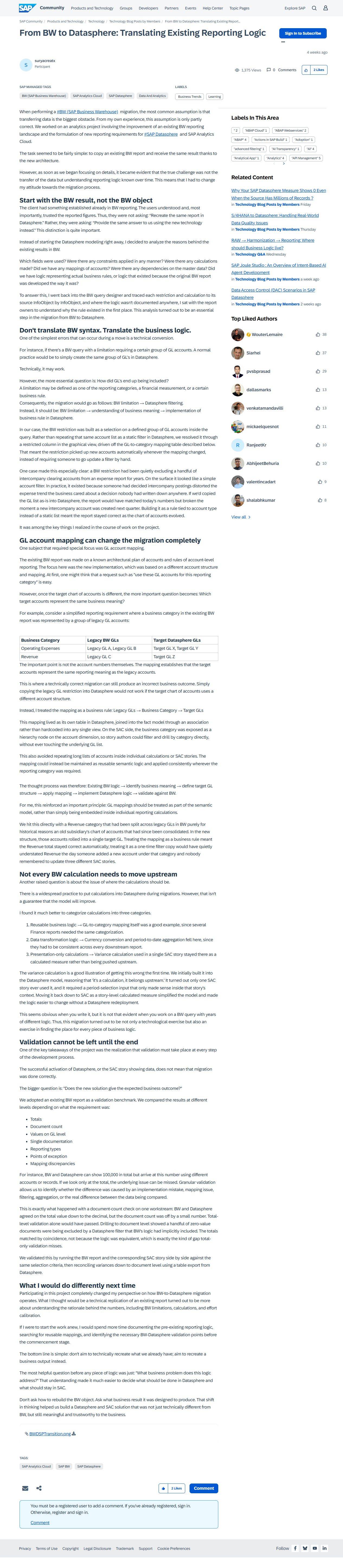
Screenshot: From BW to Datasphere: Translating Existing Reporting Logic

From BW to Datasphere: Translating Existing Reporting Logic

Relevanz: mittelSAP Datasphere17.9.2026 · Community · 2 Likes

  • Migration beginnt beim BW-Ergebnis, nicht beim BW-Objekt: Restriktionen und Kennzahlen InfoObject für InfoObject zurückverfolgen, undokumentierte Regeln mit den Report-Ownern klären.
  • Keine Syntax-Übersetzung, sondern Geschäftslogik: Beispiel GL-Kontengruppe als Restricted Column über Mapping-Tabelle statt statischem Filter — bleibt bei Kontenplan-Änderungen korrekt (Fallstrick: stille Intercompany-Ausnahmen).
  • Kernsatz: die gleiche Antwort mit neuer Technologie liefern, nicht denselben Report kopieren.
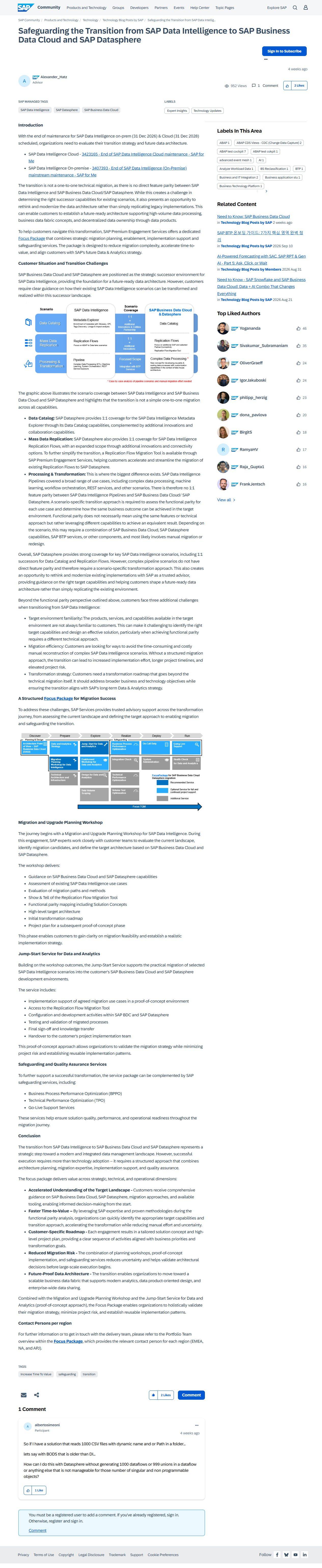
Screenshot: Safeguarding the Transition from SAP Data Intelligence to SAP Business Data Cloud and SAP Datasphere

Safeguarding the Transition from SAP Data Intelligence to SAP Business Data Cloud and SAP Datasphere

Relevanz: mittelSAP Business Data CloudSAP Datasphere17.9.2026 · SAP · 2 Likes

  • Wartungsenden Data Intelligence On-Prem 31.12.2026 und Cloud 31.12.2028; kein 1:1-Feature-Parity — Übergang als Chance zur Modernisierung statt Kopie begreifen.
  • 1:1-Abdeckung für Data Catalog (Metadata Explorer) und Replication Flows (inkl. Migrationstool über Premium Engagement); Pipelines (Processing, ML, Orchestrierung) brauchen szenariospezifische Neukonzeption aus BDC/Datasphere/BTP-Bausteinen.
  • SAP Focus Package bündelt Migrationsplanung, Enablement, Implementierung und Safeguarding.
Screenshot: SAP Datasphere CI/CD: Automating Deployments with GitHub Actions

SAP Datasphere CI/CD: Automating Deployments with GitHub Actions

Relevanz: hochSAP Datasphere15.9.2026 · Community · 3 Likes

  • Ein Workflow-File, zwei Pfade: manueller Dispatch (Export aus Space → Branch → Pull Request) und Push auf main (QA mit Approval-Gate → Verifikation → Planung → PROD mit zweitem Approval).
  • Rollback-Snapshot automatisch vor jeder PROD-Änderung; Git ist Source of Truth für Objektdefinitionen (local-tables, views, analytic-models, flows, task-chains u. a.).
  • Löst fehlenden Review-Trail bei direkter Arbeit im Space; Concurrency-Gruppe verhindert parallele Deployments.
★
Screenshot: How to connect HDLF instance to SAP Datasphere

How to connect HDLF instance to SAP Datasphere

Relevanz: mittelSAP Datasphere15.9.2026 · SAP · 3 Likes

  • Eingebaute HDLF-Instanz erlaubt keinen freien Datei-Zugriff (Parquet/CSV up-/downloaden geht nicht); dafür externe HDLF-Instanz im BTP provisionieren und anbinden.
  • Anbindung per Zertifikat: CA plus Client-Zertifikat plus Keystore (.p12) mit OpenSSL erzeugen, Trust/Auth in HDLF registrieren, REST-Endpoint als Connection in Datasphere eintragen.
  • Voraussetzungen: OpenSSL, Admin-Zugriff auf HDLF-Instanz und Datasphere-Tenant.
★
Screenshot: SAP BW Query vs. SAP Datasphere Analytic Model: Why Migration Often Means Rebuilding

SAP BW Query vs. SAP Datasphere Analytic Model: Why Migration Often Means Rebuilding

Relevanz: hochSAP DatasphereSAP Business Data Cloud15.9.2026 · Community · 7 Likes

  • Leitfrage ist nicht „migrieren oder nicht“, sondern ob die BW-Logik fachlich noch relevant ist und in eine moderne Architektur passt; oft liefert ein fachlich getriebener Rebuild mehr Wert als ein 1:1-Transfer.
  • Analytic Model ist kein Query-Ersatz: Dimensionen/Measures/Assoziationen statt Zeilen/Spalten/Strukturen, Variablen im View-/Modell-Kontext statt am InfoObject, SAC greift direkt per InA zu.
  • Zwei Szenarien: hybride Architektur (BW bleibt teilweise) vs. Greenfield-Datasphere; SQL gewinnt für berechnete und eingeschränkte Kennzahlen an Bedeutung.
Screenshot: Dynamic Hierarchy Path Generation for Flexible Restricted Measures in SAP Datasphere

Dynamic Hierarchy Path Generation for Flexible Restricted Measures in SAP Datasphere

Relevanz: hochSAP Datasphere11.9.2026 · Community · 12 Likes

  • Problem: Restricted Measure auf Member Node (N) statt manuell gepflegter Leaf-Liste (Beispiel Apple-Produkte) — neue Produkte brechen die Pflege.
  • Lösung: Hierarchy Path je Leaf (Leaf→Root, Format HIERARCHY:Node, mehrere Hierarchien per ||) per SQLScript Table Function (Cursor-Traversierung, interne Tabellen lt_hierarchy/Final).
  • Wiederverwendbar: nur Quell-Node plus Spaltenmapping tauschen; gezeigt an Kategorie- (1001) und Brand-Hierarchie (2001).
Screenshot: Explore and reuse SAP Datasphere models from Databricks

Explore and reuse SAP Datasphere models from Databricks

Relevanz: hochSAP DatasphereSAP Databricks11.9.2026 · SAP · 9 Likes

  • Zwei Wege: Rebuild (Rohdaten teilen, Joins/Measures/Hierarchien neu bauen) vs. direkt konsumieren per Live-DB-Connection auf Semantic Layer (Logik bleibt, SAC-Definitionen gelten weiter).
  • Produktionsreife Absicherung: Zertifikats-Auth (eigene CA per openssl, Client-Zertifikat, PEM/PSE-Bundle) plus Databricks Secrets für Ablage/Rotation/Audit.
  • Auch für Rückschreiben von Predictions und Exploration vor vollem Data Product geeignet; Analytic Models nur per OData (Folgeblog).
Screenshot: Finding the Where-Used List for Replication Flows in SAP Datasphere

Finding the Where-Used List for Replication Flows in SAP Datasphere

Relevanz: mittelSAP Datasphere8.9.2026 · Community · 5 Likes

  • Lücke: kein BW-ähnlicher Verwendungsnachweis (DTP→Kette) für Replication Flows — Workaround von der Task-Chain-Seite: alle Chains als JSON exportieren und per Python-Skript (Substring-Match, kein Schema-Parser) prüfen.
  • Output: where_used_result.csv (Flow × Chain × YES/no) plus discovered_replication_tasks.csv als Typo-Kontrolle; Ergebnis in Excel auf YES filtern.
  • Setup: Ordner mit task_chains-Unterordner, replication_flows.txt, find_rf_usage.py, python find_rf_usage.py — ohne Zusatzlibs, versionsrobust.
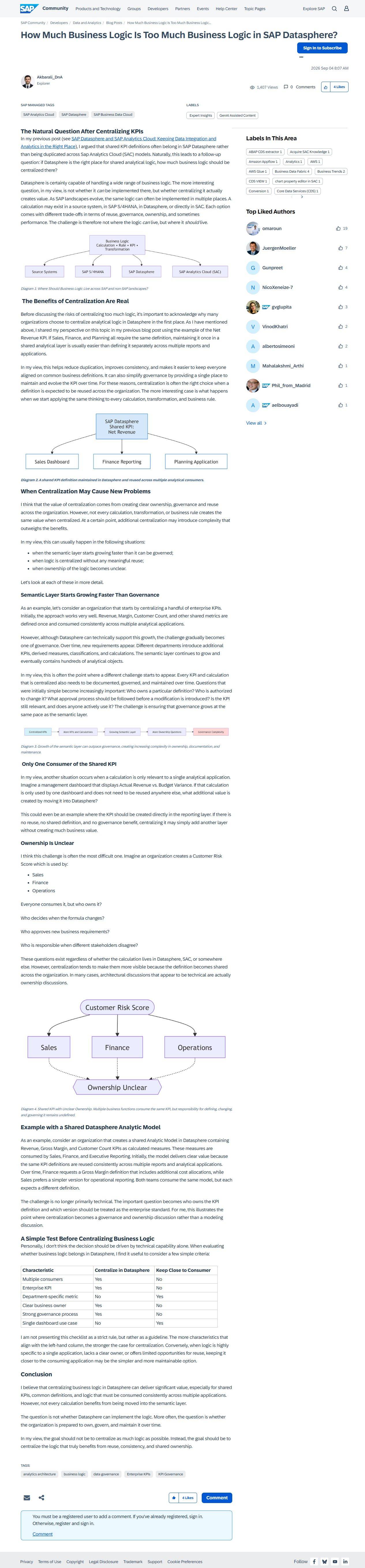
Screenshot: How Much Business Logic Is Too Much Business Logic in SAP Datasphere?

How Much Business Logic Is Too Much Business Logic in SAP Datasphere?

Relevanz: mittelSAP Datasphere4.9.2026 · Community · 4 Likes

  • Zentralisierung lohnt bei Reuse (Beispiel Net Revenue einmalig statt je Report), kippt bei: Layer wächst schneller als Governance, Logik ohne Reuse, unklare Ownership.
  • Frage ist nicht „kann?“, sondern „schafft Wert?“ — gleiche Logik kann in Quelle, S/4HANA, Datasphere oder SAC leben (Trade-offs Reuse/Governance/Ownership/Performance).
  • Folgeblog zum SAC-vs-Datasphere-Architekturpost (14447207).
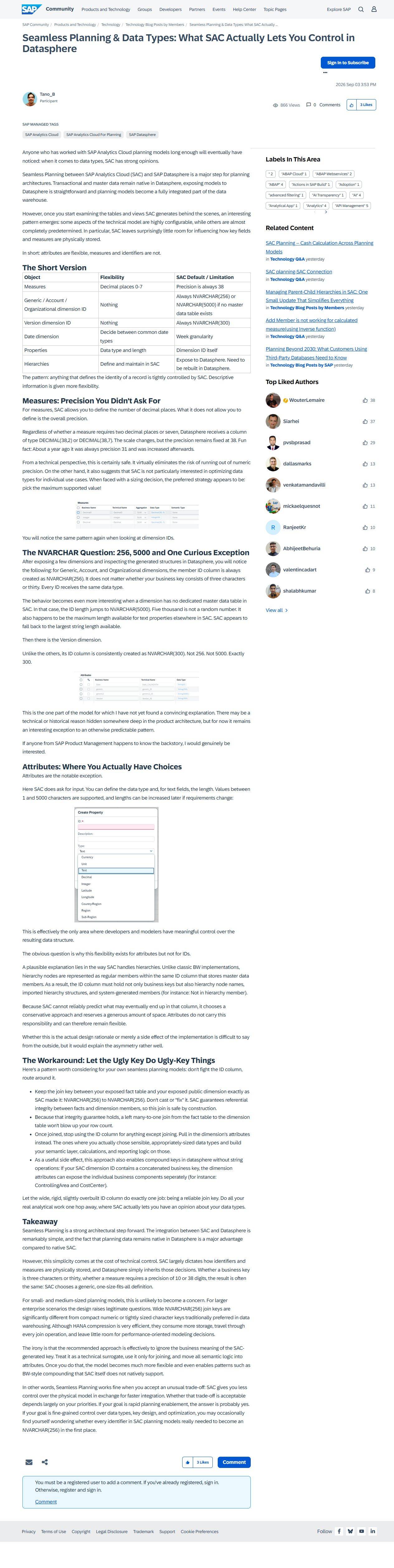
Screenshot: Seamless Planning & Data Types: What SAC Actually Lets You Control in Datasphere

Seamless Planning & Data Types: What SAC Actually Lets You Control in Datasphere

Relevanz: mittelSAP Datasphere3.9.2026 · Community · 3 Likes

  • Kurzformel: Attribute flexibel, Measures/IDs nicht — Measures immer DECIMAL(38, x) (früher 31), generische IDs NVARCHAR(256 bzw. 5000 ohne Stammdatentabelle), Version immer NVARCHAR(300).
  • Nur Datum (Wochengranularität), Properties (Typ/Länge) und Hierarchien (in SAC pflegen, in Datasphere neu aufbauen) sind gestaltbar.
  • SAC-Strategie erkennbar: im Zweifel Maximalwert statt passgenauer Typen — bei Sizing/Entscheidungen einkalkulieren.
Screenshot: A SAP Datasphere task chain monitoring agent

A SAP Datasphere task chain monitoring agent

Relevanz: mittelSAP Datasphere3.9.2026 · Community · 6 Likes

  • Teams-Frage („lief der Finance-Load?“) beantwortet ein Agent per MCP-Tools (Space finden, Status, History, Log) — auch diagnostisch („warum?“, nicht nur Status).
  • Zwei Pfade: interaktiv per @-Mention im Channel plus werktäglicher Morgen-Digest (GitHub-Actions-Cron → Agent → Power Automate Adaptive Card mit Name/Status/Zeit/Dauer/logId).
  • Effekt: Routinefragen verschwinden, Berater-Interruptions entfallen, nur echte Follow-ups bleiben.
Screenshot: Execute and Monitor SAP Datasphere Task Chains from UC4

Execute and Monitor SAP Datasphere Task Chains from UC4

Relevanz: mittelSAP Datasphere28.8.2026 · Community · 4 Likes

  • Drei-Job-Pattern (UC4/Automic als Leitscheduler): Authenticate (OAuth Client Credentials, Token-File) → Execute (Task Chain triggern, Log ID fangen) → Monitor (Status per Log ID pollen bis final).
  • Lektionen: Token allein reicht nicht (Space-Rollen!), Least Privilege per scoped Role, Variablen SPACE/TASK_CHAIN/RUNID/STATUSID, Rotation/Timeouts definieren.
  • Ziel: Azure-Folgeprozesse erst nach erfolgreicher Chain starten.
Screenshot: SAP Datasphere Integration Patterns: Lessons Learned from Two Years of Implementations

SAP Datasphere Integration Patterns: Lessons Learned from Two Years of Implementations

Relevanz: hochSAP Datasphere17.8.2026 · Community · 7 Likes

  • Pattern 1 (S/4HANA Cloud PE, Finance/GL): Remote-Zugriff zu langsam → Replication Flows (kopiert, entkoppelt, planbar) plus Partitionierung, HANA/CDS-Tuning, Cloud-Connector-Skalierung.
  • Pattern 2 (Ariba): CAP + HDI-Container + Integration-Suite-iFlow (Jobs, Download, Transform, Upsert, Fehler/Monitoring) plus Task Chains.
  • Fokus: Volumen, Security, Orchestrierung, Monitoring, Automatisierung über SAP-/Non-SAP-Quellen (Files, Kafka).
Screenshot: Dynamic Current Month, Year-to-Date, Current Year and Previous Measures in SAP Datasphere

Dynamic Current Month, Year-to-Date, Current Year and Previous Measures in SAP Datasphere

Relevanz: hochSAP Datasphere13.8.2026 · Community · 9 Likes

  • Muster: MTH/YTD/PY-MTH/PY-YTD/PY als Restricted Measures auf Reporting-Monat/Jahr (Defaults aus letzter geschlossener CO-Periode) — Ansatz 1 berechnete Spalten im Fact View (P0/P1/P2 per CASE/ADD_YEARS) ist einfach, blockiert aber Persistierung bei Parameter-Abweichung.
  • Empfohlen (Ansatz 2): Fact View variablenfrei halten, Restricted Measures dynamisch im Analytic Model über Helper-Views (BW-Customer-Exit-Analogie) auf Calendar-Month-Dimension.
  • BW-Hintergrund willkommen: MTH = Jahr+Monat, YTD = Monate <= Reporting, PY = Vorjahr.
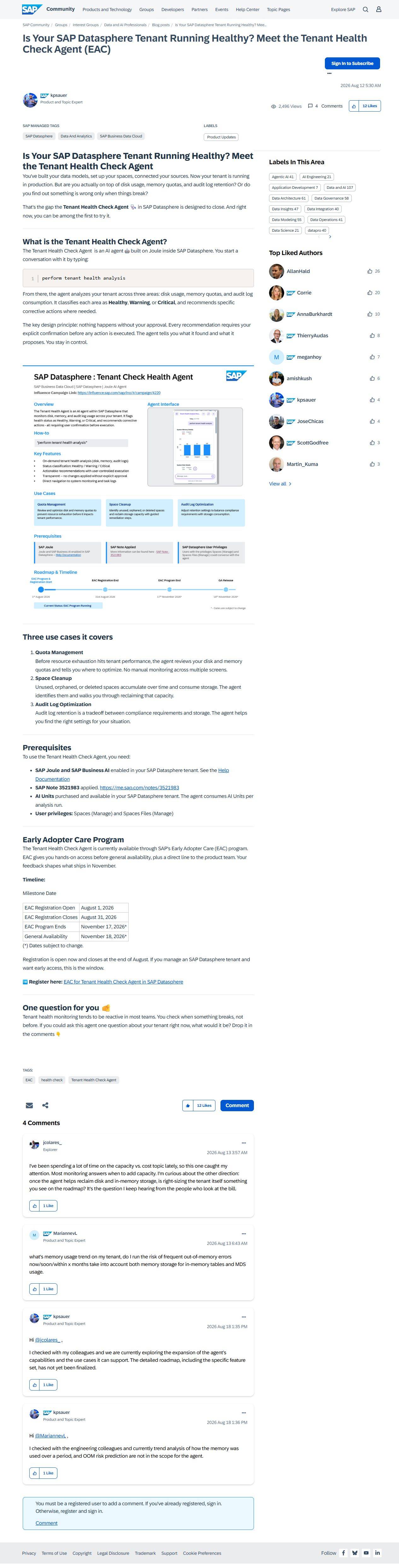
Screenshot: Is Your SAP Datasphere Tenant Running Healthy? Meet the Tenant Health Check Agent (EAC)

Is Your SAP Datasphere Tenant Running Healthy? Meet the Tenant Health Check Agent (EAC)

Relevanz: hochSAP Datasphere12.8.2026 · Community · 12 Likes

  • Joule-Agent (Prompt „perform tenant health analysis“) prüft Disk, Memory-Quotas, Audit-Log-Verbrauch mit Ampel Healthy/Warning/Critical plus Maßnahmen — nichts ohne explizite Bestätigung.
  • Drei Use Cases: Quota Management, Space Cleanup (verwaiste/gelöschte Spaces), Audit-Log-Optimierung (Compliance vs. Speicher).
  • Voraussetzungen: Joule + Business AI, Note 3521983, AI Units, Space-(Files-)Manage-Rechte; EAC bis 17.11.2026, GA 18.11.2026.
Screenshot: SAP Datasphere and SAP Analytics Cloud: Keeping Data Integration and Analytics in the Right Place

SAP Datasphere and SAP Analytics Cloud: Keeping Data Integration and Analytics in the Right Place

Relevanz: hochSAP Datasphere7.8.2026 · Community · 7 Likes

  • Zwei Ansätze: SAC als Integrationsschicht (schnell, gut für klein) vs. Datasphere als Datenschicht (skalierbar, governbar) — mit Wachstum drohen in SAC doppelte KPI-Logik (Beispiel Net Revenue) und wachsende Integrationskomplexität.
  • Empfehlung: geteilte Definitionen (KPIs, Transformationen, Semantik) zentral in Datasphere, SAC für Visualisierung/Planung.
  • Beispielquellen S/4HANA, SuccessFactors, CRM, Excel; Dashboards, Sales, Finance, Planning.
Screenshot: How to Consume SAP Datasphere Analytical Models to SAP Fiori Using OData Services

How to Consume SAP Datasphere Analytical Models to SAP Fiori Using OData Services

Relevanz: hochSAP Datasphere6.8.2026 · SAP · 5 Likes

  • Kette: Fact View des Analytic Models „Expose for Consumption“ → Trust BTP↔Datasphere (Destination-Trust-XML, Provider Name + Signing Certificate unter App Integration) → OAuth (SAML Bearer für User-Propagation empfohlen, Client Credentials für Technical User) → BTP-Destination → Fiori/CAP.
  • Stolperfalle: Fact View exposen, nicht nur das Model — sonst kein OData.
  • Voraussetzungen: Admin-Rechte beidseitig, deploytes Model, OAuth-Client-Rechte.
Screenshot: Currency Conversion in SAP Datasphere: Understanding TCUR* Tables and Practical Implementation

Currency Conversion in SAP Datasphere: Understanding TCUR* Tables and Practical Implementation

Relevanz: mittelSAP Datasphere23.7.2026 · Community · 4 Likes

  • Framework: TCURC (Codes), TCURV (Kurstypen M/B/G), TCURR (Kurse), TCURF (Faktoren), TCURN (Notierungen), TCURX (Dezimalstellen) — Wechselkurs allein reicht nicht (Faktoren, Notierung, Datum, Genauigkeit).
  • Zwei Teile: Framework-Verständnis plus Umsetzung/Validierung/Troubleshooting in Datasphere (Abgleich gegen S/4HANA, Beispiel CAD/EUR→USD).
  • Ergänzt den CONVERT_CURRENCY-Praxisblog (Sep); GenAI-assistiert, vom Autor verifiziert.
Screenshot: Mastering SAP Datasphere Replication Scheduling

Mastering SAP Datasphere Replication Scheduling

Relevanz: mittelSAP Datasphere22.7.2026 · Community · 4 Likes

  • Drei Verfahren: Frequency-Based (5/10/15/20/30 Min. bis monatlich, ohne Expertise), Simple Schedule (grafisch, Zeitzonen/DST-sicher, Standard für ETL/ELT), Cron (z. B. viertelstündlich nur werktags, letzter Sonntag — volle Präzision).
  • Faustregeln: stündlich Transaktionen, täglich Stammdaten off-peak, wöchentlich Partner, monatlich Snapshots; passend zum Bedarf wählen statt überkomplex.
  • Nutzen: Frische, weniger Betrieb, verlässliches Reporting, Ressourcenschonung.
Screenshot: SAP Datasphere Master Data – Attributes, Texts, and Hierarchies

SAP Datasphere Master Data – Attributes, Texts, and Hierarchies

Relevanz: hochSAP Datasphere21.7.2026 · SAP · 11 Likes

  • Ende-zu-Ende am G/L-Account: Quellen per Replication Flow holen (Stamm, Texte, Hierarchy Nodes + Texte) → zwei Graphical Views (Hierarchie per Union, Konten mit Text) → Dimension → SAC Seamless Planning.
  • Wichtig: Seamless Planning konsumiert Hierarchien anders als Analytic Models (dort Assoziationen + Hierarchy Semantics) — Modellierung darauf ausrichten.
  • Muster übertragbar auf Customer, Product, Cost/Profit Center u. a.; Folgeblog zu Analytic Models angekündigt.
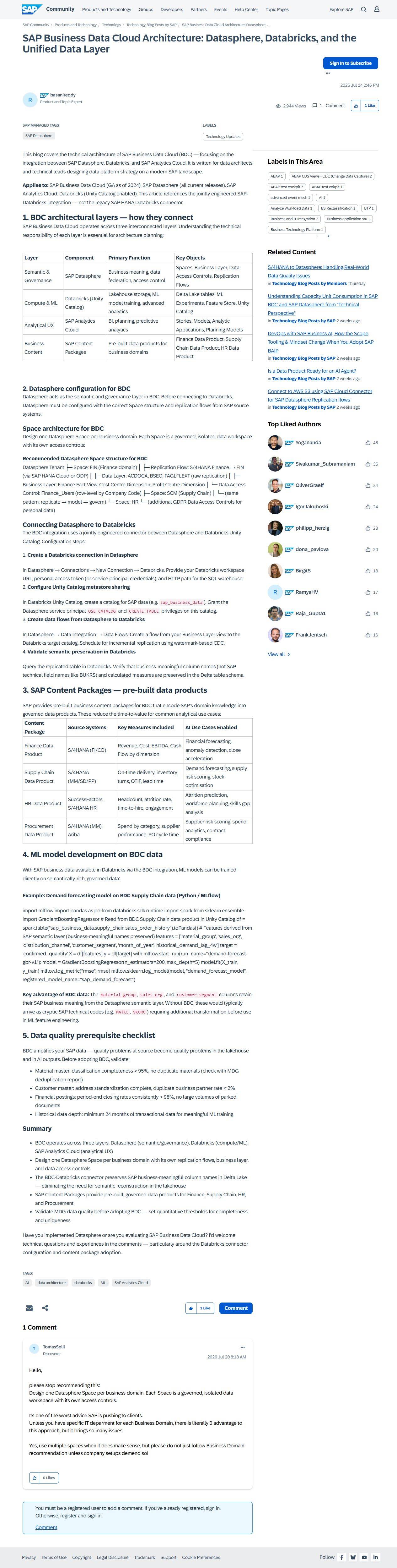
Screenshot: SAP Business Data Cloud Architecture: Datasphere, Databricks, and the Unified Data Layer

SAP Business Data Cloud Architecture: Datasphere, Databricks, and the Unified Data Layer

Relevanz: mittelSAP Business Data CloudSAP DatasphereSAP Databricks14.7.2026 · SAP · 1 Likes

  • 3 Schichten: Datasphere (Semantik/Governance: Spaces, Business Layer, DACs, Replication Flows), Databricks/Unity Catalog (Lakehouse, ML, Delta/Feature Store), SAC (BI/Planung) plus Content Packages (Finance/SC/HR).
  • Setup-Muster: ein Space je Domäne (FIN mit ACDOCA/BSEG/FAGLFLEXT + DAC je Buchungskreis), Databricks-Connection (URL, Token/Service Principal, SQL Warehouse), Unity-Katalog sap_business_data (USE/CREATE), Data Flows mit Watermark-CDC, Semantik-Check in Delta.
  • Gilt für BDC GA 2024+, jointly engineered Connector (nicht alter HANA-Connector).
Screenshot: Start remote Process/Actions in BTP ABAP via Task Chains from SAP Datasphere

Start remote Process/Actions in BTP ABAP via Task Chains from SAP Datasphere

Relevanz: hochSAP Datasphere14.7.2026 · SAP · 6 Likes

  • Drei Optionen: (1) direkter API-Call (einfach, Batch/Event-Driven), (2) Integration Suite (komplexe Mappings, Governance, iFlow-Reuse), (3) CAP-App (eigene Logik, Persistenz, Microservice).
  • Aufbau: Task Chain mit API-Task → generische HTTP-Connection → ABAP-Cloud-Inbound-Web-API; dort Communication System/Arrangement, Inbound Service/Binding, Szenario, Service Definition, Klassen (z. B. processData).
  • Voraussetzungen: Datasphere Dev+Admin, ABAP-Umgebung Dev, OAuth/Communication-Arrangements, Web-API-Entwicklung.
Screenshot: SAP S/4HANA Custom ABAP CDS View to Datasphere: Replication Flow Setup, Status & Delta Processing

SAP S/4HANA Custom ABAP CDS View to Datasphere: Replication Flow Setup, Status & Delta Processing

Relevanz: hochSAP Datasphere10.7.2026 · SAP · 26 Likes

  • CDC-Kette: DB-Trigger auf Basistabellen → Master Logging → Subscriber Logging → Buffer Table → Replication Flow; Rollen RMS (Orchestrierung), APE (ABAP-Extraktion, Initial/Delta), Modi Initial-only/Delta/Initial+Delta.
  • RMS-Jobs (SM37, DDIC): CDC_HEALTH_CHECK, DHCDC_DISPATCHER, OBSERVE_LOGTAB (~1h), PUSH_CDS_DELTA (~6h); Monitoring DHCDCMON/DHRDBMON, Tuning Intervalle/WP mit Basis abstimmen.
  • Designrat: Standard-CDS/Data Products bevorzugen statt direkter ABAP-Tabellen (Kontextverlust); Custom-CDS per Annotation CDC-mappen, Inserts/Updates/Deletes Ende-zu-Ende validieren.
Screenshot: Unit Conversion in SAP Datasphere using T006 (LB to KG Example)

Unit Conversion in SAP Datasphere using T006 (LB to KG Example)

Relevanz: mittelSAP Datasphere8.7.2026 · Community · 3 Likes

  • Standard statt Eigenlogik: T006D (Dimension, z. B. MASS mit SI-Einheit KG) plus T006 (Einheiten + Faktoren G/KG/OZ/LB/TON) — nur innerhalb einer Dimension konvertieren.
  • Umsetzung: Fact View auf Quelltabelle (z. B. ACDOCA, MSL/RUNIT), zwei berechnete Spalten (MSL_Converted, RUNIT_Converted) per CONVERT_UNIT im Formula-Node.
  • Use Cases: Inventory, Procurement, Materialbewegungen, länderübergreifendes Reporting; Validierung gegen Erwartungswerte.
Screenshot: Need to Know - Beyond SAP Analytics Cloud AI and Using SAP Databricks in SAP Business Data Cloud

Need to Know - Beyond SAP Analytics Cloud AI and Using SAP Databricks in SAP Business Data Cloud

Relevanz: mittelSAP Business Data CloudSAP Databricks11.6.2026 · SAP · 7 Likes

  • Überblicksserie: BDC-Bausteine (Data Products, Foundation Services/ORD, Intelligent Apps, SAC, Datasphere, BW PCE, BDC Connect) und Abgrenzung SAC-Bordmittel vs. Databricks.
  • Beispiel-Walkthrough: BDC Intelligent App abonnieren → Delta Sharing → Training in SAP Databricks → Ergebnisse zurück → Datasphere/SAC-Report.
  • Einordnung: BDC ist Managed SaaS + Business Data Fabric (kein Rebranding), GA seit 2024.
Screenshot: Create a Custom SAP BDC Data Product share it with Enterprise Databricks, extend it and send it back

Create a Custom SAP BDC Data Product share it with Enterprise Databricks, extend it and send it back

Relevanz: hochSAP Business Data CloudSAP DatabricksSAP Datasphere18.5.2026 · Community · 13 Likes

  • Roundtrip: Custom Data Product in BDC → Enterprise Databricks anreichern → zurück nach BDC (Governance/Lineage bleibt erhalten).
  • Sizing-Hinweis: mind. 4.150 CU, Storage 384 GB + Memory 128 GB, Object Store je 1 Block Storage/Memory/Requests (Estimator).
  • Voraussetzungen: BDC Core + Datasphere + BDC Connect in gleicher Region (Egress!), HDLF-Space mit Scope-Rolle, Cloud Connector für S/4 (4 Hilfenotes verlinkt).
Screenshot: Sharing SAP S/4HANA Data with Databricks Using BDC Connect and Delta Sharing

Sharing SAP S/4HANA Data with Databricks Using BDC Connect and Delta Sharing

Relevanz: hochSAP DatasphereSAP Business Data CloudSAP Databricks10.4.2026 · Community · 4 Likes

  • Kette: S/4HANA (nur released CDS, APRS Push Replication) → Datasphere Object Store (Parquet) → Managed Data Product → BDC Connect → Delta Sharing → Databricks (zero-copy, governed).
  • S/4-Voraussetzungen: Note 3500131 (ABAP Integration), Note 3561739 (Technical Jobs), SJOBREPO-Jobs grün (Dispatcher, Daemons, Housekeeper), CDC-Jobs healthy.
  • Danach Data Packages im BDC Cockpit aktivieren (Dauer je Volumen/CDS-Anzahl/Paralleljobs); Delta Sharing geht nur auf Object Store, nicht HANA-Tabellen.
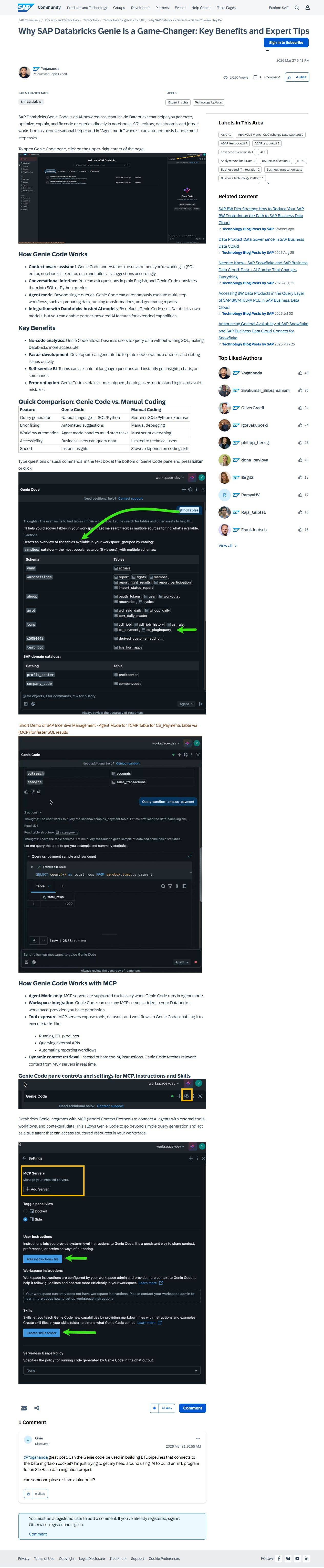
Screenshot: Why SAP Databricks Genie Is a Game‑Changer: Key Benefits and Expert Tips

Why SAP Databricks Genie Is a Game‑Changer: Key Benefits and Expert Tips

Relevanz: mittelSAP Databricks27.3.2026 · SAP · 4 Likes

  • Genie Code: kontextsensitiver Assistent in Notebooks/SQL/Dashboards/Jobs — NL→SQL/Python, Fix-Vorschläge, Agent Mode für mehrstufige Tasks.
  • MCP nur im Agent Mode: Workspace-MCP-Server als Tools (ETL, APIs, Reporting), dynamischer Kontext statt hartcodierter Prompts.
  • Nutzen: No-Code-Analytics, schnelleres Entwickeln, Self-Service-BI, weniger Fehler (Demo Incentive Mgmt via MCP).
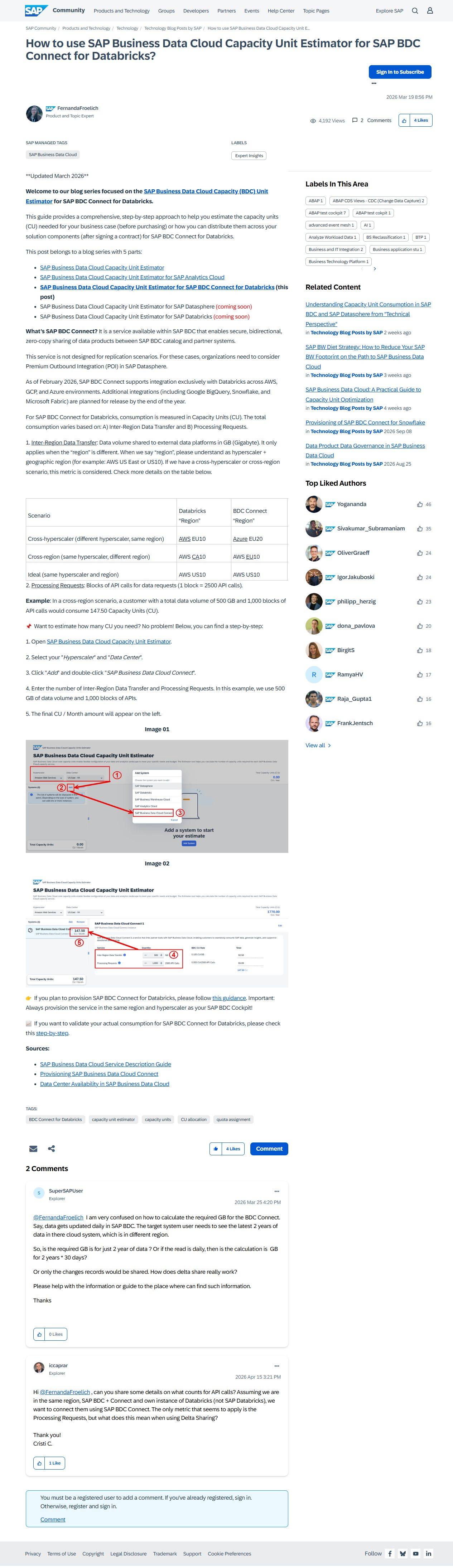
Screenshot: How to use SAP Business Data Cloud Capacity Unit Estimator for SAP BDC Connect for Databricks?

How to use SAP Business Data Cloud Capacity Unit Estimator for SAP BDC Connect for Databricks?

Relevanz: mittelSAP Business Data CloudSAP Databricks19.3.2026 · SAP · 4 Likes

  • Verbrauch nur aus Inter-Region Transfer (GB, nur bei anderem Hyperscaler/Region) plus Processing Requests (Blöcke à 2500 API-Calls); Beispiel 500 GB + 1000 Blöcke = 147,50 CU.
  • 5 Klicks im Estimator: Hyperscaler/Datacenter → Add → BDC Connect → Mengen eintragen → CU/Monat ablesen.
  • Einordnung: BDC Connect = Sharing, kein Replikationsersatz (dafür POI); Stand Feb 2026 nur Databricks, BigQuery/Snowflake/Fabric geplant.
Screenshot: Triggering SAP Databricks Jobs through SAP Datasphere Task Chains

Triggering SAP Databricks Jobs through SAP Datasphere Task Chains

Relevanz: hochSAP DatasphereSAP Databricks17.3.2026 · SAP · 7 Likes

  • Generic-HTTP-Connection (Host, Port 443, Pfad /api/2.1, Auth User „token“ + PAT als Passwort) plus API-Task auf Jobs-endpoint runs/submit.
  • PAT unter User → Settings → Developer → Access Tokens erzeugen; Use Cases von Pipeline-Automatisierung bis ML-Training per Datenfluss.
  • Voraussetzungen: Datasphere-Rechte für Connections/Task Chains, Notebook-Zugriff, REST-Grundlagen.
Screenshot: Integrating SAP Databricks with SAP CPQ and SAP Datasphere for Analytics & Reporting

Integrating SAP Databricks with SAP CPQ and SAP Datasphere for Analytics & Reporting

Relevanz: hochSAP DatabricksSAP Datasphere6.3.2026 · SAP · 8 Likes

  • 4 Schichten: CPQ-REST-APIs (OAuth2) → Databricks (PySpark-ETL, Unity Catalog, Delta Lake) → Delta Sharing + BDC/ORD → Datasphere/SAC-Konsum.
  • Anforderungen: <5 Min. Latenz bei 100k+ Angeboten/Tag, RBAC + Verschlüsselung, GDPR/SOX; Entitäten Quotes, Line Items, Kunden, Produkte.
  • Ziel: Single Source of Truth für CPQ mit Lineage und (Near-)Real-Time.
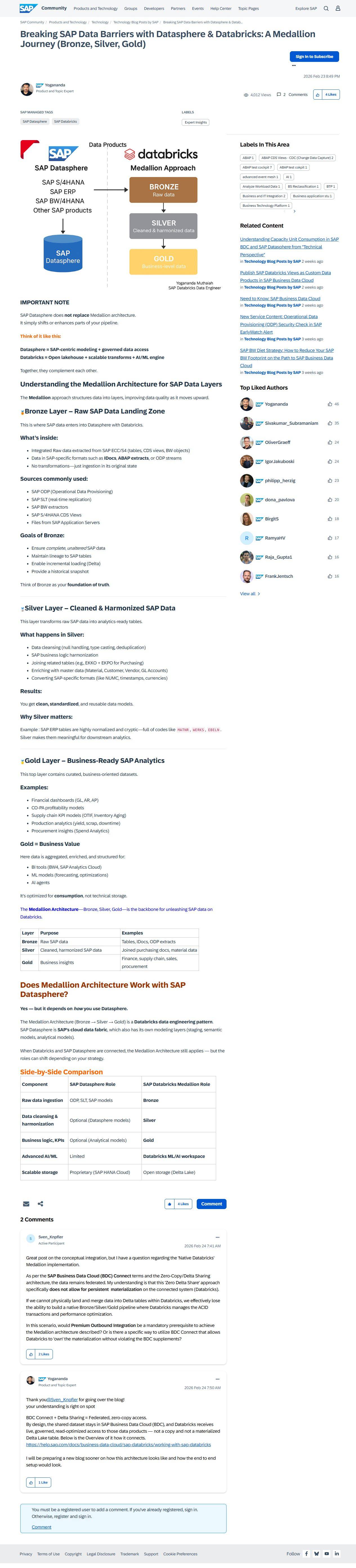
Screenshot: Breaking SAP Data Barriers with Datasphere & Databricks: A Medallion Journey (Bronze, Silver, Gold)

Breaking SAP Data Barriers with Datasphere & Databricks: A Medallion Journey (Bronze, Silver, Gold)

Relevanz: hochSAP DatasphereSAP Databricks23.2.2026 · SAP · 4 Likes

  • Rollenbild: Datasphere = SAP-zentrische Modellierung + Governance, Databricks = offenes Lakehouse + Transforms + AI/ML; Datasphere ersetzt Medallion nicht, sondern ergänzt es.
  • Bronze (roh: IDocs, ABAP-Extrakte, ODP/SLT, CDS, Files; Lineage + Delta), Silver (cleansen, harmonisieren, MATNR/WERKS/EBELN auflösen, Währungen), Gold (GL/AR/AP, CO-PA, OTIF, Spend für SAC/ML/Agents).
  • Quellen: ODP, SLT-Echtzeit, BW-Extraktoren, CDS-Views, App-Server-Files.
Screenshot: Automating Invoice Predictions from SAP Databricks with SAP Datasphere Task Chain

Automating Invoice Predictions from SAP Databricks with SAP Datasphere Task Chain

Relevanz: hochSAP DatabricksSAP DatasphereSAP Business Data Cloud11.2.2026 · Community · 22 Likes

  • Task Chain orchestriert Databricks-Jobs per REST (run-now/get-run, Service Principal): Notebook triggern, Ausführung überwachen, Prognosen aktuell in BDC halten — vollautomatisch bei neuen Rechnungen.
  • Drei Komponenten: DSP Task Chains (REST API Task + Generic HTTP Connection), Databricks Jobs API, Delta Sharing + Unity Catalog für Live-Konsum in BDC.
  • Finance-Nutzen: schnellere Mahnläufe, weniger Überfälliges, besseres Working Capital; technisch valide, aber offiziell nicht supportet.
Screenshot: Hands-on Tutorial (SAP) Databricks triggering ML in SAP Datasphere

Hands-on Tutorial (SAP) Databricks triggering ML in SAP Datasphere

Relevanz: hochSAP DatabricksSAP Datasphere9.2.2026 · SAP · 15 Likes

  • Databricks-Notebook ruft SAP PAL-Prognose in Datasphere auf — ohne Datenbewegung; Use Case Bedarfsforecast auf 80 Mio. Versandzeilen für Workforce Planning (Repo auf GitHub).
  • Voraussetzungen: Datasphere Script Server, Database User (Credentials in Databricks Secrets), hochgeladene Daten, Demand-Forecast-Flow mit Exploration/Preparation/Time-Series.
  • Prognose zurück in Datasphere weiterverwendbar.
Screenshot: Developing HANA ML models with SAP Databricks

Developing HANA ML models with SAP Databricks

Relevanz: hochSAP DatabricksSAP Business Data Cloud4.2.2026 · SAP · 8 Likes

  • hana-ml plus Databricks-managed MLflow: Training/Inferenz auf HANA-Cloud-Daten (SQL-Zugriff, HANA-Compute) mit Notebook-Komfort und ohne eigenen MLflow-Server.
  • Anbindung: 4 Parameter (URL, Port 443, User, Passwort via Databricks Secrets), Databricks-IP auf Allow-List, DB-Rechte AFLPAL/AP L (OpenSQL-User mit APL/PAL in Datasphere).
  • Gilt für SAP Databricks in BDC und Enterprise Databricks via bdc-connect; Datensätze aus HANA, HDLFS-Föderation oder installierten BDC Data Products.
Screenshot: Connecting SAP Analytics Cloud to Databricks model serving endpoint

Connecting SAP Analytics Cloud to Databricks model serving endpoint

Relevanz: hochSAP Databricks31.12.2025 · SAP · 8 Likes

  • SAC Multi Action mit API-Schritt ruft Databricks Model Serving Endpoint auf; beide Seiten OAuth 2.0, Service Principal außerhalb der Databricks-UI.
  • SAC-HTTP-Connection braucht 5 Parameter: Data Service URL, OAuth Client ID, Secret, Token URL, Scope.
  • Gilt für native und SAP Databricks gleichermaßen; Voraussetzungen SAC BI-Admin/Planning plus Databricks Workspace Admin.
Screenshot: How to provision SAP BDC Connect for Databricks?

How to provision SAP BDC Connect for Databricks?

Relevanz: hochSAP Business Data CloudSAP Databricks27.11.2025 · SAP · 10 Likes

  • 17-Schritte-Anleitung (Stand Jan 2026): SAP for Me → Portfolio & Products → BDC → Applications → Start Provisioning; Name, Resource Group, CU-Quote (nur Richtwert, Estimator), Connection Identifier aus Databricks.
  • Voraussetzungen: Super-/Cloud-Admin mit BDC-Installation, BDC Cockpit provisioniert, gleiche Region/Hyperscaler, Databricks-Workspace mit Unity Catalog + Delta Sharing, CREATE PROVIDER/RECIPIENT-Rechte.
  • Danach Formation aus BDC Connect, Datasphere und Cockpit bilden; bis 30 Min. warten, URL aus Notification in Databricks einkleben.
Screenshot: Integrating Non-SAP Semi-Structured Invoices Data with SAP BDC Using SAP Databricks

Integrating Non-SAP Semi-Structured Invoices Data with SAP BDC Using SAP Databricks

Relevanz: hochSAP DatabricksSAP Business Data Cloud27.11.2025 · Community · 14 Likes

  • PDF-Rechnungen aus S3 als binaryFile streamen, mit pypdf parsen (Checkpoint in Unity-Catalog-Volume), nach Delta-Tabelle bt_delta_table_invoice_pdf schreiben.
  • RandomForestRegressor (scikit-learn) für Payment Delays, Registry in Unity Catalog, Batch Inference nach bt_invoices_payment_delay_predictions_new.
  • Ergebnis per Delta Share zero-copy als customer-managed Data Product in den BDC Catalog publizieren und dort abrufen.
Screenshot: SAP Business Data Cloud – Leveraging SAP Databricks' assistant to easily build predictive scenarios

SAP Business Data Cloud – Leveraging SAP Databricks' assistant to easily build predictive scenarios

Relevanz: hochSAP DatabricksSAP Business Data Cloud26.11.2025 · SAP · 5 Likes

  • 7 Schritte am Beispiel Absatzprognose auf S/4HANA-Aufträgen: Data Product teilen → Notebook → Daten holen → transformieren → Forecast → visualisieren → Ergebnistabelle Product_Forecast materialisieren.
  • Databricks Assistant generiert Zugriffs-, Transformations- und Prognosecode — auch ohne Databricks-Tiefenwissen.
  • Ergebnisse als Tabelle für Folgeanalysen weiterverwendbar.
Screenshot: SAP BDC - Enhance a BW Data product with SAP Databricks - Part II

SAP BDC - Enhance a BW Data product with SAP Databricks - Part II

Relevanz: hochSAP Business Data CloudSAP Databricks3.11.2025 · SAP · 6 Likes

  • Teil 2 der Serie: Anomalieerkennung auf GL-Buchungen (Isolation Forest, unüberwacht) direkt auf dem geteilten BW-Data-Product in Databricks-Notebooks (Python).
  • Use Case Abschlussprüfung: falsche Kontotyp-Kombinationen, falsche Beträge, untypische Proportionen als Betrugs-/Fehlerhinweise statt manuellem Sampling.
  • Datensatz-Exploration über Unity Catalog (Delta Shares Received, s4_figl4_raw_data) plus SQL Explorer.
Screenshot: BW Data Product Generator to Databricks Enterprise Capability

BW Data Product Generator to Databricks Enterprise Capability

Relevanz: hochSAP Business Data CloudSAP Databricks31.10.2025 · SAP · 12 Likes

  • 4 Schritte: DPG installieren (Note 3590400, Note Analyzer, STRUST-Zertifikate, Task SAP_BW_BDC_CONFIGURATION re-runnable), DPG auf BW-Content laufen lassen, Data Product anlegen, per Delta Share nach Enterprise Databricks teilen.
  • Subscription-Typen: Base Provider (Cubes, DSO classic/advanced, InfoObjects), Composite/MultiProvider, Query-as-Infoprovider; nach Save noch aktivieren.
  • Zugang über Data-Subscriptions-Kachel im BW-Cockpit (BW/4HANA) bzw. SAP GUI (BW 7.5).
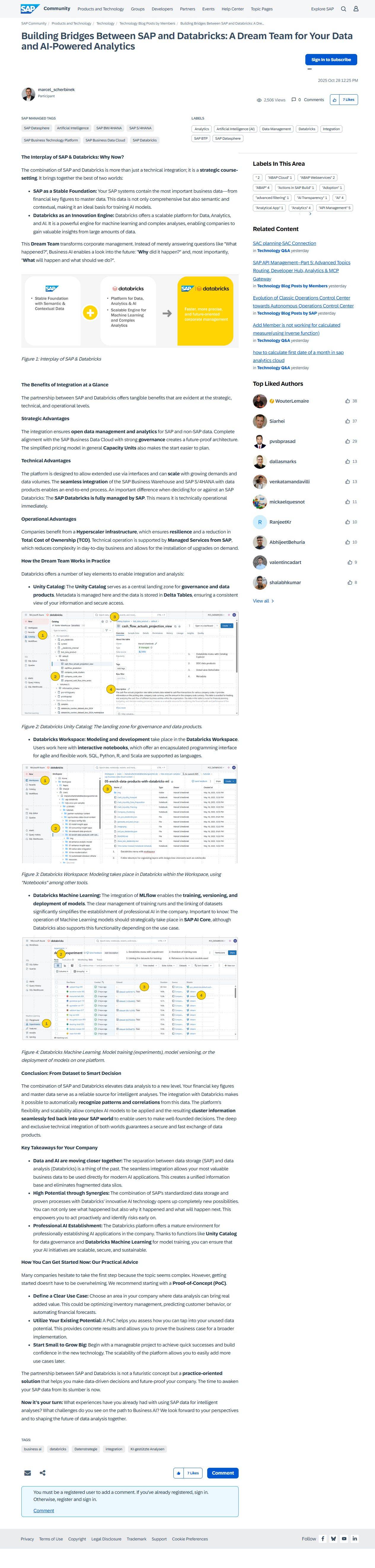
Screenshot: Building Bridges Between SAP and Databricks: A Dream Team for Your Data and AI-Powered Analytics

Building Bridges Between SAP and Databricks: A Dream Team for Your Data and AI-Powered Analytics

Relevanz: mittelSAP DatabricksSAP Business Data Cloud28.10.2025 · Community · 7 Likes

  • Strategiebild: SAP als semantische Datengrundlage, Databricks als Innovations-Engine (ML, Skalierung); SAP Databricks voll gemanagt und sofort betriebsbereit.
  • Bausteine: Unity Catalog (Governance, Delta Tables), Workspace (Notebooks in SQL/Python/R/Scala), MLflow (Training, Versionierung, Deployment; Betrieb strategisch eher in SAP AI Core).
  • Blick über Deskription hinaus: von „Was passierte?“ zu „Warum?“ und „Was wird passieren?“.
Screenshot: Sharing Data Products from SAP Databricks to SAP Business Data Cloud - Official Python SDK

Sharing Data Products from SAP Databricks to SAP Business Data Cloud - Official Python SDK

Relevanz: hochSAP DatabricksSAP Business Data Cloud18.10.2025 · SAP · 5 Likes

  • Voraussetzung: Unity-Catalog-Privilegien (CREATE CATALOG/SHARE, SET SHARE PERMISSION, USE PROVIDER/RECIPIENT/SHARE) für den Sharing-User.
  • Ablauf: Delta Share anlegen (Schemas/Tabellen wählen, Recipient sap-business-data-cloud) und per iPython-Notebook mit Metadaten als Data Product publizieren.
  • Richtung Databricks→BDC (Gegenstück zum Konsum in Datasphere).
Screenshot: SAP BDC - Enhance a BW Data product with SAP Databricks

SAP BDC - Enhance a BW Data product with SAP Databricks

Relevanz: hochSAP Business Data CloudSAP Databricks15.10.2025 · SAP · 13 Likes

  • Teil 1 der Serie: Data-Product-Subscription auf Custom-BW-Infoprovider (DPG, Rolle SAP_BW4_MODELER_FOR_BDC) und Replikation nach BDC; Voraussetzung BW 7.50 SP26+/BW/4HANA 2021 SP04+/2023 SP04+ plus Note 3590400.
  • Unterstützte Infoprovider: physisch (Cubes, DSO/ADSO, InfoObjects), virtuell (Composite/MultiProvider) sowie Query-as-Infoprovider; Full- oder Delta-Modus mit Filtern und Prozessketten-Varianten.
  • Teil 2 nutzt die GL-Daten für ML-Anomalieerkennung in Databricks.
Tagesrecherche. Englischsprachige SAP-Community-Blogs zu SAP Datasphere, SAP Business Data Cloud und SAP Databricks: praktische Anleitungen und relevante Neuigkeiten. Fragen, Forenbeiträge und reine Veranstaltungsankündigungen werden ausgeklammert. Recherchezeitraum und Importstatus stehen in der Archivstatusanzeige; nach Fehlern wird das offene Recherchefenster nachgeholt.

Manuelle Auswahl. Über „Blog hinzufügen“ können Sie SAP-Community-Blogs unabhängig von Alter, Sprache und Themenbezug aufnehmen. Diese Beiträge werden auf Deutsch zusammengefasst und als „Manuell hinzugefügt“ gekennzeichnet.